Guan’s blog

home

Public companies data

13 Feb 2011

People have been asking for the data I used to generate the stock listings charts that Felix posted. Here they are on Google Docs:

You should be able to generate the various charts I made and also anything else. The main charts count the number of companies with common stock listed on NYSE or one of NYSE, AMEX or NASDAQ. A company with multiple share classes listed is only counted once. Companies listed outside the US (according to CRSP) are not counted.

Here is the number of companies listed on NYSE, AMEX or NASDAQ since 1973, which is when NASDAQ firms started appearing on the CRSP tape:
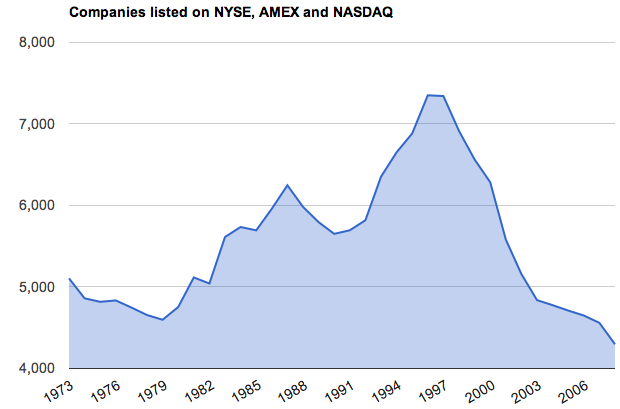
The number of listed companies has declined since around 1998. The overall number of US firms increases every year, so a falling percentage of firms are listed. This is true however you want to measure this, for example as a ratio of employer firms or all firms. On the other hand, if the companies that are still listed are still very large in terms of sales, employment, value added or some other measure of size, then the overall importance of public companies to the economy may be unchanged, or even increase. I tried to compare various measures to measures for all US employer firms from the Economic Census. (The data I’ve provided should allow you to compute other measures of the importance of public companies in the economy.) The Economic Census also has separate data for firms sorted by size, so I can focus on the large firms that are most likely to be listed on an exchange.
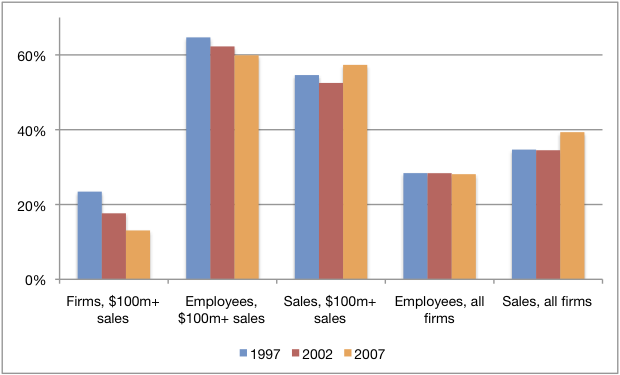
It’s not obvious what exactly has happened to public firms since 1997. Fewer large firms with at least $100 million in sales are listed, and public firms have a smaller employment share, but their sales have actually increased, both as a proportion of large firms and of all employer firms.

One obvious problem with my data is that I measure worldwide sales and employment of the listed companies, while the Economic Census figures for all firms are for the US only.

Backup strategy

11 Feb 2011

A couple of days ago My MacBook Pro refused to boot, or even play the Apple boot chime, so I decided to start being paranoid about backups again. I used to have an external hard drive with a bootable copy of my drives, but I somehow lost the power adapter for it. External hard drive prices being what they are, I decided to buy a hard drive dock and just go with raw drives now. ($89.99 for 2 TB is cheap!)

For backups, I now do:

  • Two separate bootable hard drive backups with SuperDuper!.
  • Time Machine backup into a 900 GB volume on the disk that holds one of the bootable backups.
  • Dropbox keeps a backup of most of my documents.
  • Online Backblaze backup of all non-system files smaller than 4 GB.
  • Arq backup onto Amazon S3 of documents and a bunch of other files.
At some point I should rent a safe deposit box and put one of the SuperDuper! drives in there.

With the cheap storage solution that the hard drive dock provides—if I can live with swapping drives back and forth—I should probably be more of a packrat. I keep a local copy of many of the financial datasets I use for research, which means I have to update them when new versions are available. When these updates occur, old data tends to change in unpredictable and annoying ways. One particularly bad incident was when the CRSP “Survivor-Bias-Free” Mutual Fund Database switched data providers from Morningstar to Lipper, dropping a lot of funds and introducing new survivorship biases. My plan is now to buy a bunch of 2 TB disks and keep a copy of every version I have access to so I won’t be affected if something like this happens.

Hi !

07 Feb 2011

Welcome to my blog. Don’t expect much. Especially you, Alex Chinco.