Guan’s blog

home

Mobile sites and mobile URLs

19 Apr 2011

A lot of websites have versions optimized for the smaller screens of mobile browsers. For example, the iPhone version of this blog looks like this:

What’s even nicer is that WordPress and the Basic Maths theme I use can automatically detect that you are coming from an iPhone or other mobile browser and show this version. You’ll notice that it simply displays the mobile version, but the URL of the page is still http://guan.dk/. This means that I can send this link or tweet it to a person who would view it on a larger web browser, and they would get the standard version and would never know that I have a mobile version of the site. This is nice because the mobile version would look weird on a larger screen:

The wonderful blog Boing Boing also has a nice mobile version that iPhone and other mobile browsers are automatically shown:
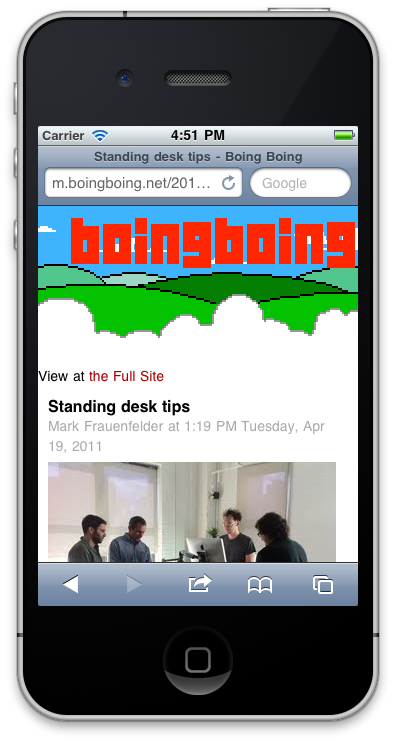
Unfortunately, they have implemented this by redirecting to m.boingboing.net, a separate domain name. This is not so annoying with the mobile version of a site like Facebook where users are less likely to share “deep” links, but there are two problems for content-based websites where users are likely to share links.

  1. It unnecessarily creates multiple URLs for the same resource, which makes it hard to detect that two links actually point to the same thing.
  2. When a mobile user shares the link in an email or tweet and a desktop user clicks on it, the desktop user is shown the mobile version:
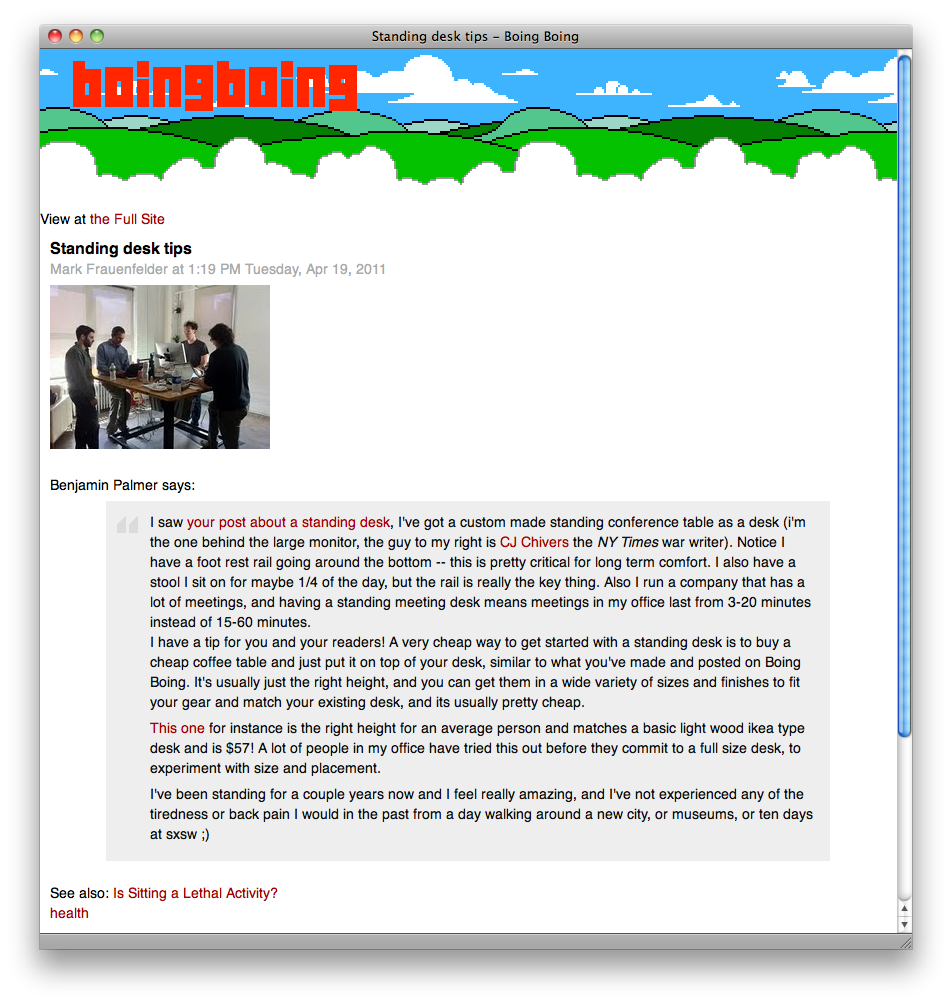
I know that there is an option to switch to the full site, but it’s still not nice. Boing Boing and other sites that do this should either display a mobile version without changing the domain name (but still retain an option to view the full site), or change their software’s default behavior to redirect desktop users to the full site.

100 years of IBM

19 Apr 2011

Via Jessica Bigarel.

New Yorker abstracts

25 Mar 2011

Like many publications, The New Yorker makes some of its articles freely available on their website, but restrict others to subscribers only, in this case with the “digital edition” (which is horrible, but that’s a different story). Most publications that operate with this model provide the first few paragraphs of the story to give the user some sense of the story and whether he should log in (or subscribe) to read it.

The New Yorker, on the other hand, writes wonderfully detailed abstracts that actually describe the article in a terse, neutral tone. Here are some examples:

409 words:

The resulting product has sold nine million pairs since October of 2000, when Blakely started Spanx. Before Spanx, shapewear was associated with the aging and the piteous. Now unmentionables are objects of boasting. Mentions Oprah Winfrey, Gwyneth Paltrow, and Kim Kardashian. Itzler is a former rapper and a co-founder of Marquis Jets. He currently owns a marketing and “business incubation” company called Suite 850. Blakely has already expanded into legwear, lacy lingerie, casual separates, and retro swimwear. … Only thirteen of the hundred and five employees are men, and the offices resemble a hygienic bordello, with pink shag carpeting and pink velvet sofas. Mentions Spanx C.E.O. Laurie Ann Goldman. Jadideah Duckham, Spanx’s director of research and development, is responsible for one of Spanx’s most successful innovations: the Bra-llelujah, which took three years and more than a hundred prototypes to perfect. Mentions Amy Quick and Sylma Colon-Otten. Tells about Blakely meeting the Proenza Schouler designers, Lazaro Hernandez and Jack McCullough, at the Jeffrey Fashion Cares benefit.

24 words:

Short story about a Japanese man who attempts to piece together his reaction to his divorce by taking a trip north to bleak Hokkaido.

415 words:

Tells about Novitzky’s career and his investigation into the Bay Area Laboratory Co-Operative, or BALCO, run by Victor Conte. Also discusses Greg Anderson, Bonds’s friend and former trainer, who was an associate of Conte’s. Writer visits Conte at his office in San Carlos, California. Discusses Bonds’s career and his achievements on the field. If he is convicted, Bonds will almost certainly get no more than a few months of jail time. Mentions Bonds’ former girlfriend, Kimberly Bell, who will testify at the trial. Also tells about Iran White, an undercover narcotics officer who befriended Anderson with the goal of getting to Bonds.

185 words (the full article has more discussion of each point):

SHOUTS & MURMURS about a new activity called GOING OUTSIDE. Introducing GOING OUTSIDE, the astounding multipurpose activity platform that will revolutionize the way you spend your time. GOING OUTSIDE is not a game or a program, not a device or an app, not a protocol or an operating system. Instead, it’s a comprehensive experiential mode that lets you perceive and do things firsthand. GOING OUTSIDE: 1. Supports real-time experience through seamless mind-body interface. By GOING OUTSIDE, you’ll rediscover the joy and satisfaction of actually doing something. 2. Is completely hands-free. No keyboards, mice, controllers, touch pads, or joysticks. 3. Delivers authentic 3-D, real-motion video, with no lag time or artifacts. 4. Delivers “head-free” surround sound. No headphones, earbuds, speakers, or sound-bar arrays required—and yet, amazingly, you hear everything. 6. Enables complete interactivity with inanimate objects, animals, and Nature. 11. Provides access to everything not in your home, dorm room, or cubicle. Millions of people have already tried GOING OUTSIDE. Many of “your” friends may even be GOING OUTSIDE right now! Why not join them and see what happens?

Why do they do abstracts like this? Who writes them?

Dwolla launches instant ACH

25 Mar 2011

I mentioned Dwolla as an example of a payment service based on cheap ACH transfers. I’ve even used them to transfer between two of my own accounts at different banks, but it takes 2–3 business days for each leg of the transfer (to and from Dwolla). I once asked the BankSimple folks about their ACH strategy, and they told me that the biggest reason for the slowness is that ACH procedures are still rooted in an age when payment information was exchanged with magnetic tapes mailed around the country.

Tonight TechCrunch brings news that Dwolla is launching a service called FiSync that lets banks integrate them directly. The post doesn’t provide a lot of detail, but I’m guessing it means that the bank notifies Dwolla of the upcoming ACH payment directly and Dwolla can release the money based on this notification. If this is actually how it works, Dwolla would need to take some credit risk because the money may never show up.

I am certainly interested in the details of how clearing will work, but in any case this will make the Dwolla experience much smoother if they can convince enough banks to participate, and perhaps the US will finally have a cheap, widely available retail payment system that doesn’t rely on Visa or MasterCard.

Update: The blog post and press release are out now. It seems I was too optimistic. From what I can tell, FiSync only reduces the initial time it takes to register a bank account with Dwolla. When you add a bank account to your account, they make two small test deposits that you must then verify on the website. This process may be familiar from PayPal or other services that use ACH. The test deposits take 2 to 3 business days to complete, like most ACH deposits, and it is this wait that FiSync will eliminate by allowing the customer to instantly authorize Dwolla to link to the bank account. At least from what I can tell, regular ACH deposits and withdrawals will not be any faster, at least at this stage of FiSync.

Interesting sentence of the day

23 Mar 2011

Tyler Cowen:

An open economy, with lots of trade, is usually much freer than traditional statistics will make it seem.