Corporate “personhood” is settled law. Corporeal Art is a thing of the past (see Death of the Author), and Corporate Art - art made for an by great masses of people, intended, not for an intimate experience between on viewer and an “autonomous” object, but instead as a “projection” to be watched in large public settings by a boisterous crowd, is the Art that most perfectly fit to the modern moment.
Corporate art > corporeal art
Creepy speech
Reddit allows all those creepy subreddits because its business model is built on memberships and visits, and the dudes who visit these subreddits are almost certainly enthusiastic members and visitors. This is a perfectly valid reason, in the sense of “valid” meaning “allowing people to be creepy isn’t inherently illegal, and we make money because of it, so we’ll let it happen.” But while it makes sense that the folks at Reddit are either actively or passively allowing “we’re making money allowing creeps to get their creep on” to be muddled with “we’re standing up for the principles of free speech,” it doesn’t mean anyone else needs be confused by this.
It’s very possible that Reddit is making a lot of money from ads on the creepy subreddits and subscription revenue from creepy members, but tolerating creepy speech could also be a way to signal that they welcome free speech of all stripes, even very unpopular speech.
Chart adventures of the day
Felix presents an interesting chart:
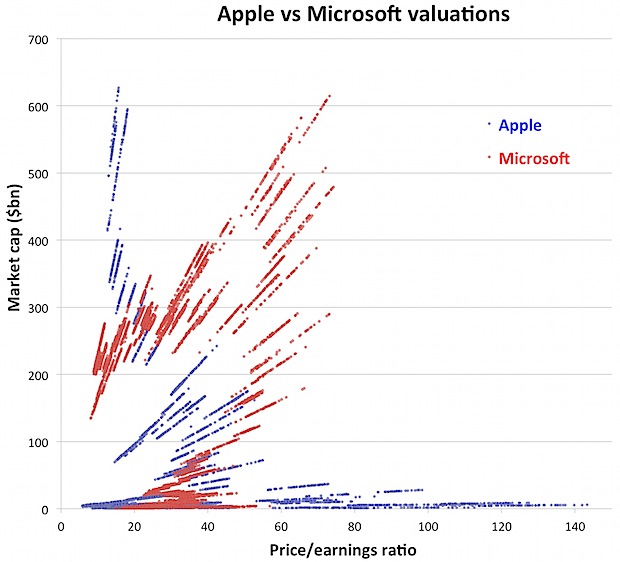
This chart plots daily observations of the market cap of Apple and Microsoft against the companies’ price/earnings ratio. The message is that Apple’s large market cap has coincided with the low price/earnings ratio of a mature company, while Microsoft at its peak was priced as a growth company.
Do you see the many clusters of dots that appear as line segments? They’re there because the “earnings” in price/earnings are only updated once a quarter.
Think of price/earnings-per-share as equal to market cap/earnings. For the 60-plus trading days in a quarter, when you plot market cap against market cap/earnings, all the dots are on a line with slope 1/earnings. You can justify plotting all the individual daily observations on the grounds that they represent independent valuations of Apple or Microsoft. The problem is that the chart interprets all increases in price/earnings during a quarter as an increase in a valuation ratio, but it could just as well be due to changed expectations of short-term earnings. The final chart looks messy and implies that there’s more information than there really is.

I’ve created my own version here that’s less visually exciting, but shows the same information in a more concise form. For each quarter, I’ve plotted the average of the daily market caps that quarter against the price/earnings ratio based on earnings during the previous four quarters. (This data is only through 2011 because we graduate students can’t afford the most recent data.) This chart illustrates the same underlying message without the line segment artifacts created by using daily observations.
(If the chart looks small, make your browser window wider or click through.)
How Julian Assange will escape
It’s still possible that Julian Assange will spend the rest of his life, or maybe just 15 years, in Flat 3B. But that’s no fun.
It’s been suggested that even if he can get into a diplomatic car, the British can arrest him when he leaves the car to board a plane for Quito.
However, if he can get into the car, the Ecuadorian embassy driver could simply drive him through the Chunnel to a friendly country that will let him board a plane. He wouldn’t be able to leave the car to use the bathroom, which is a problem unless that country is France. Are there diplomatic RVs?
They could also drive the car onto a ferry that could sail out to international waters so a helicopter can pick up Assange, or it could just ferry him all the way to Guayaquil.
How would he get into the car though? The Ecuadorian embassy does not have a courtyard or a connected garage. On the other hand it appears to be on a low floor, so maybe they could pull up a diplomatic convertible next to the building and Assange could jump out from a window into the car. The British police might try to apprehend him mid-air, so I predict the construction of some kind of diplomatic chute that he will slide down. Alternatively they could soak him in oil so he’ll be too slippery to catch.
Update: Ecuador could also buy a flying diplomatic car for the trip.
Writing software is wrong
On the latest episode of Build and Analyze, Marco Arment tries to reconcile his belief that copyright infringement is always wrong and never a legitimate form of protest—we should simply stop consuming the works in question—with his statement that almost all software developers will inevitably and unavoidably practice and infringe a software patent. He does this by saying that developers will inadvertently infringe a patent that the developer didn’t even know about, but you almost never accidentally copy a song or movie or tv episode.
I don’t think this distinction gets him very far. If I randomly copy a big chunk of a friend’s early jazz collection and start playing it on shuffle, is that not just as wrong? True, some of the songs could be published under a Creative Commons license or even in the public domain. I don’t know for a fact that my copying any specific song is infringement, especially if I’ve never heard these songs before and don’t know when they were published, or even who the author is. But I have almost certainly infringed someone’s copyright.
You never accidentally write a piece of software and publish it. Xcode doesn’t type up code by itself (though that would be an awesome feature) and Apple does not steal binaries from your computer and upload them to iTunes Connect without your permission. If you know that by publishing your app you have practiced someone’s patent, that’s also wrong even if you don’t know which patent it is. If the probability is high enough that you are infringing a patent, it shouldn’t matter very much that you don’t know which patent it is.
I wouldn’t necessarily conclude that copyright infringement is ever the right thing to do, or not wrong, but it follows naturally from Marco’s position on copyright infringement that publishing software in the current patent regime is wrong. So Marco should stop doing that.
PS: Don’t stop selling Instapaper, I love that app.